

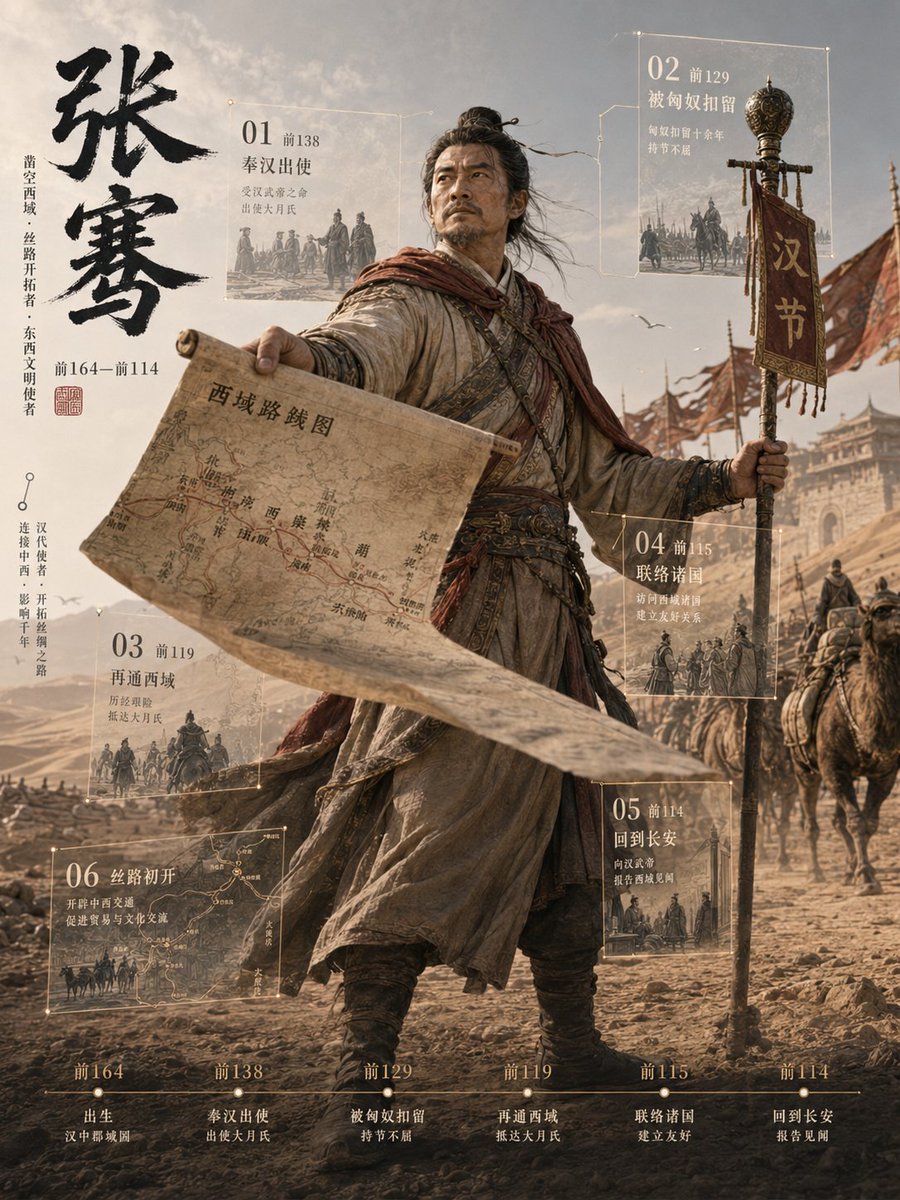
Goal: Create a vertical cinematic 3D historical figure archive poster about [character name], showing an ancient Chinese explorer breaking out of a documentary-style timeline layout with strong depth and motion.

Canvas: Vertical 3:4 poster, sepia desert palette, high-detail realistic 3D render mixed with aged parchment infographic design. Use dramatic backlight, dusty atmosphere, wind-blown fabric, shallow depth of field, and a grand Silk Road expedition mood.

Main subject: A full-body ancient Han dynasty envoy stands in the center foreground on a rocky desert road. His face is intentionally covered by a soft square pixelated blur. He wears layered worn robes, leather belts, travel wraps, boots, and a red-brown scarf blowing in the wind. His left arm stretches forward holding a large unrolled parchment map that projects toward the viewer in forced perspective; the map is labeled in Chinese as [map title] and contains route lines and place names. His right hand holds a tall ceremonial staff with an ornate metal finial and a hanging vertical red banner reading [banner text]. Behind him, show a caravan of camels, riders, soldiers, flags, and a distant western-region city gate under a hazy sky with birds.

Left title column: Place huge black ink-brush Chinese calligraphy vertically reading [main title]. Add smaller vertical Chinese descriptors beside it describing him as an opener of the Western Regions and Silk Road pioneer, plus dates “前164—前114” and a small red seal stamp. Keep the typography elegant, historical, and museum-like.

Floating archive panels: Use exactly 6 translucent glass-and-gold-line information cards around the figure, each with thin borders, small glowing corner nodes, miniature monochrome historical scene illustrations, and Chinese headings. Count and place them as follows: 1) upper left card, “01 前138 奉汉出使”, with a small envoy departure scene; 2) upper right card, “02 前129 被匈奴扣留”, with a captivity or horsemen scene; 3) lower left-middle card, “03 前119 再通西域”, with a caravan scene; 4) right-middle card, “04 前115 联络诸国”, with diplomats and allies; 5) lower right card, “05 前114 回到长安”, with return-to-capital imagery; 6) bottom-left large card, “06 丝路初开”, showing a route map and camel caravan.

Bottom timeline: Add one thin horizontal timeline across the bottom with exactly 6 labeled milestones, evenly spaced: “前164 出生 汉中郡城固”, “前138 奉汉出使 出使大月氏”, “前129 被匈奴扣留 持节不屈”, “前119 再通西域 抵达大月氏”, “前115 联络诸国 建立友好”, “前114 回到长安 报告见闻”. Use small serif-like Chinese type, warm off-white ink, and subtle gold tick marks.

Visual style: Epic historical realism, photorealistic cloth and leather textures, parchment infographic overlay, museum exhibition poster, ancient Chinese frontier expedition, desert dust, wind, warm bronze and beige tones, sharp foreground map, cinematic perspective, volumetric light, ultra-detailed 3D立像档案 aesthetic.

Constraints: Preserve exactly one central figure, one large parchment map, one ceremonial staff with one hanging banner, six floating archive cards, and six bottom timeline milestones. Avoid modern objects, avoid extra panels, avoid neon colors, and do not add a watermark.



0 Comments
👥 Co-learning Circle 0
Observe other members' variables & configurations, and click "Study & Retry" to instantly import settings and practice!