

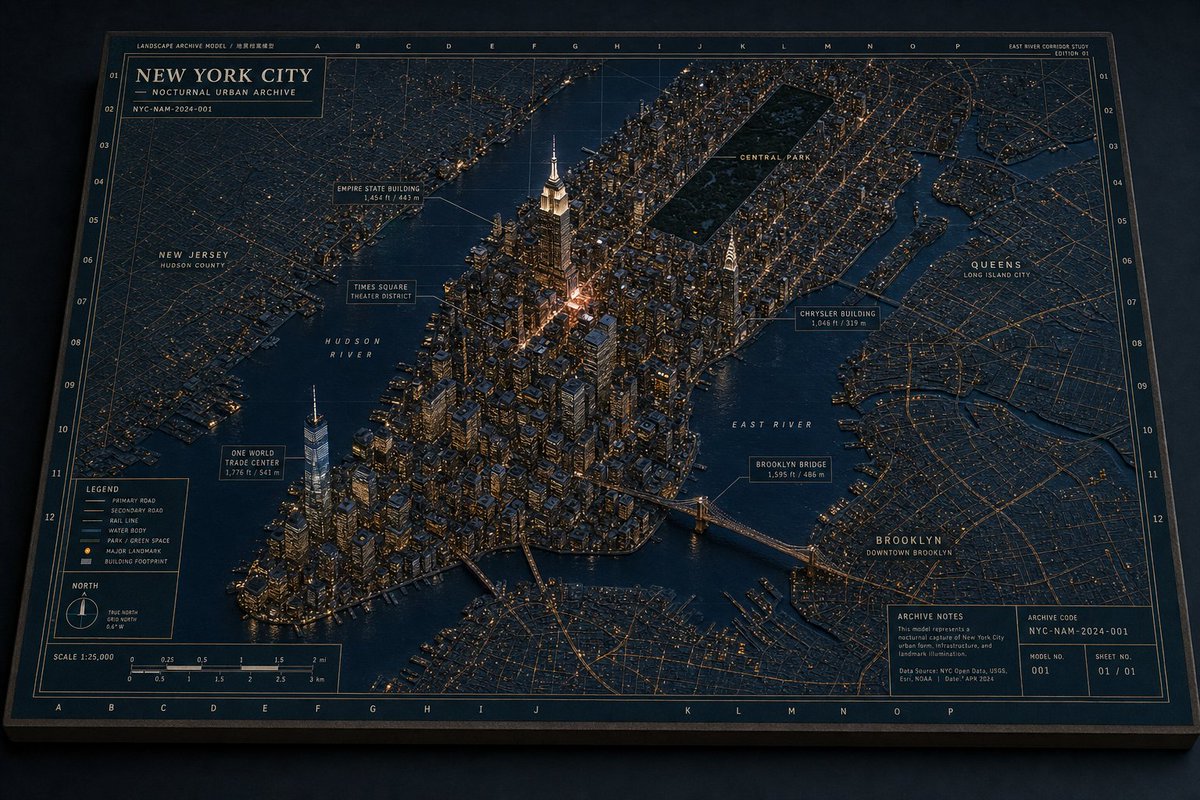
Goal: Create a highly detailed physical “Landscape Archive Model” museum diorama of [city name] at night, presented as an architectural archive board with a raised 3D city model integrated into a flat cartographic map.

Canvas: Wide horizontal 16:9 image, photographed from an oblique overhead angle like a premium editorial product shot. The board sits on a dark surface with subtle shadows, a thick matte edge, and tactile paper/cardboard texture. Use a restrained night palette of deep navy, charcoal blue, muted brass, warm amber window lights, cream annotation lines, and dark green park areas.

Layout: The entire image is one large rectangular archive plate with a thin double-line border, coordinate grid letters along the top and bottom, coordinate numbers along both sides, and faint technical map grid lines. The central area shows Manhattan as a dense raised miniature city, surrounded by darker flat-map boroughs and waterways. The 3D buildings should look like matte architectural model blocks with tiny lit windows and cast shadows. The waterways are dark blue, slightly satin, and labeled directly on the map.

Main title block: Place a boxed title panel in the upper left reading exactly “NEW YORK CITY”, with smaller lines “NOCTURNAL URBAN ARCHIVE” and “NYC-NAM-2024-001”. Add tiny archive text above it such as “LANDSCAPE ARCHIVE MODEL / 地景档案模型”. Add a small top-right study label reading “EAST RIVER CORRIDOR STUDY” and “EDITION 01”.

Subject details: Show Manhattan as the main raised island, packed with hundreds of small buildings and warm light points. Include a tall glowing Empire State Building near midtown, a bright cluster around Times Square, One World Trade Center near lower Manhattan, the Chrysler Building on the east side, Brooklyn Bridge crossing the East River, and a rectangular dark Central Park inset near the top-center of Manhattan. Surrounding flat-map areas should include New Jersey on the left, Queens on the right, and Brooklyn in the lower right.

Counted visible map labels: Include exactly 15 prominent callouts/region labels: 1) “NEW JERSEY / HUDSON COUNTY”, 2) “HUDSON RIVER”, 3) “ONE WORLD TRADE CENTER / 1,776 ft / 541 m”, 4) “TIMES SQUARE / THEATER DISTRICT”, 5) “EMPIRE STATE BUILDING / 1,454 ft / 443 m”, 6) “CENTRAL PARK”, 7) “CHRYSLER BUILDING / 1,046 ft / 319 m”, 8) “EAST RIVER”, 9) “BROOKLYN BRIDGE / 1,595 ft / 486 m”, 10) “QUEENS / LONG ISLAND CITY”, 11) “BROOKLYN / DOWNTOWN BROOKLYN”, 12) “LEGEND”, 13) “NORTH”, 14) “SCALE 1:25,000”, 15) “ARCHIVE NOTES”. Use thin cream leader lines and small boxed annotation plates for landmark callouts.

Legend and information panels: In the lower left, create one boxed legend with exactly 6 legend entries: “PRIMARY ROAD”, “SECONDARY ROAD”, “RAIL LINE”, “WATER BODY”, “PARK / GREEN SPACE”, and “MAJOR LANDMARK / BUILDING FOOTPRINT”. Below or near it, include one small north arrow compass and one scale bar labeled in miles and kilometers. In the lower right, create one archive notes box with a paragraph of tiny technical text plus exactly 4 metadata fields: “ARCHIVE CODE NYC-NAM-2024-001”, “MODEL NO. 001”, “SHEET NO. 01 / 01”, and data-source text in very small print.

Visual style: Ultra-realistic miniature architectural model photography mixed with precise cartographic design, museum archive aesthetic, sharp details, physical paper grain, slightly worn board edges, amber pinprick lights, clean serif title typography, tiny monospaced technical labels, and dramatic but soft nocturnal studio lighting.

Constraints: Keep the image as a single finished physical archive board, not a digital UI. Maintain exact visible landmark hierarchy and the listed label count. No people, vehicles, logos, watermark, or extra decorative text. Preserve the nighttime restrained color palette and the tactile model-map hybrid look.



0 Comments
👥 Co-learning Circle 0
Observe other members' variables & configurations, and click "Study & Retry" to instantly import settings and practice!